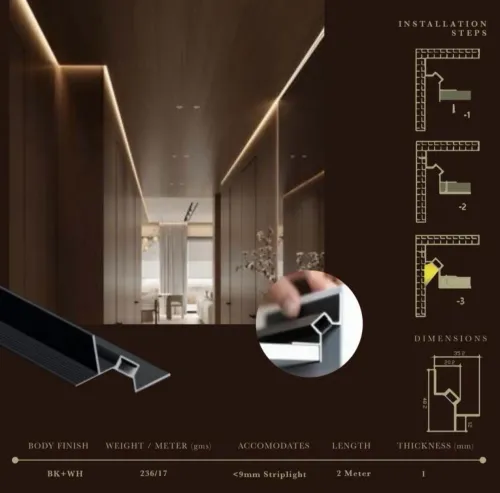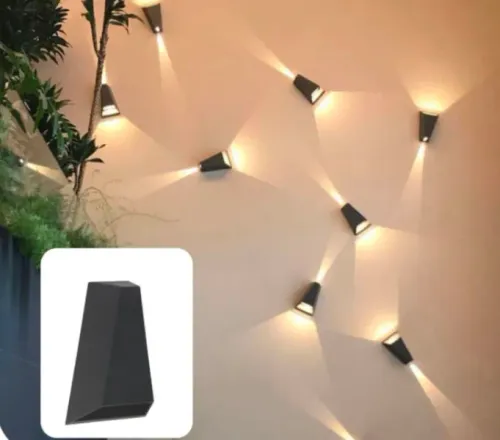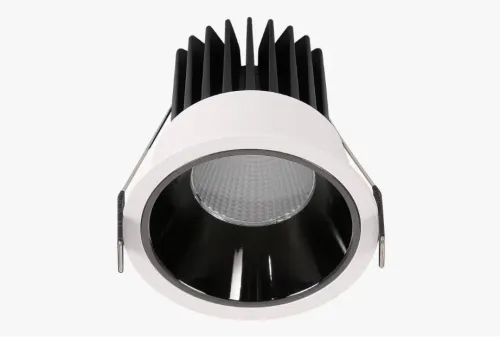
The right spotlight depends on where the light lands, how high it is mounted, what guests or staff need to see, and how the ceiling and electrical system are built. By the end, you will be able to compare beam angles, aiming options, colour quality, glare control, installation constraints and supplier documents before approving a luminaire.
Key takeaways
- Match beam angle to mounting height, target size and fixture spacing.
- Use adjustable spotlights when artwork, displays or layouts may change.
- Specify colour temperature, CRI, glare control and surface finishes together.
- Request photometric files, electrical data and control compatibility before comparing suppliers.
Match the beam angle to the mounting height and target
Beam angle is useful only when matched to mounting height, target size and spacing. A narrow beam at a low office ceiling creates bright pools and dark gaps; a wide beam from a high hotel ceiling spreads light past the artwork, table or desk and wastes emphasis.
| Beam spread | Suitable target and zone | Main risk |
|---|---|---|
| 10–20° narrow | Guest-room artwork, signage or a small reception feature from a higher ceiling | Harsh hotspots and dark gaps if spacing or aiming is wrong |
| 24–40° medium | Reception desks, restaurant tables, meeting-room tables and hotel corridors | Uneven faces or tabletops when fixtures are spaced too far apart |
| 45–60° wide | Open-plan workstations, circulation areas and low-ceiling general lighting | Low contrast, spill onto walls and screens, and reduced visual emphasis |
For cob spotlights for hotels and offices, request an IES or LDT file and a layout calculation, not a beam-angle claim alone. Check maintained illuminance, uniformity, glare and spill at the actual mounting height. Open-plan offices commonly target about 500 lux on the maintained work plane, but average lux does not prevent glare on monitors.
Choose cob spotlights for hotels by zone rather than using one fixed beam across an entire floor. Reception and display areas need controlled emphasis; corridors need even guidance; guestrooms need separately switched or dimmed ambient, reading and accent light. Deep-set optics, baffles and a larger luminous aperture reduce glare better than simply lowering wattage.
A COB package does not define the beam, efficiency or colour quality, so compare the complete luminaire.
Choose between fixed, adjustable and alternative spotlight formats
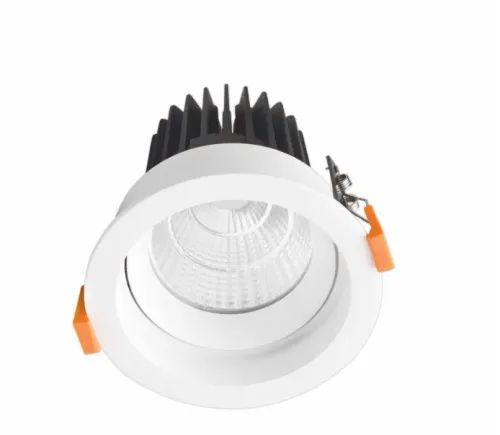
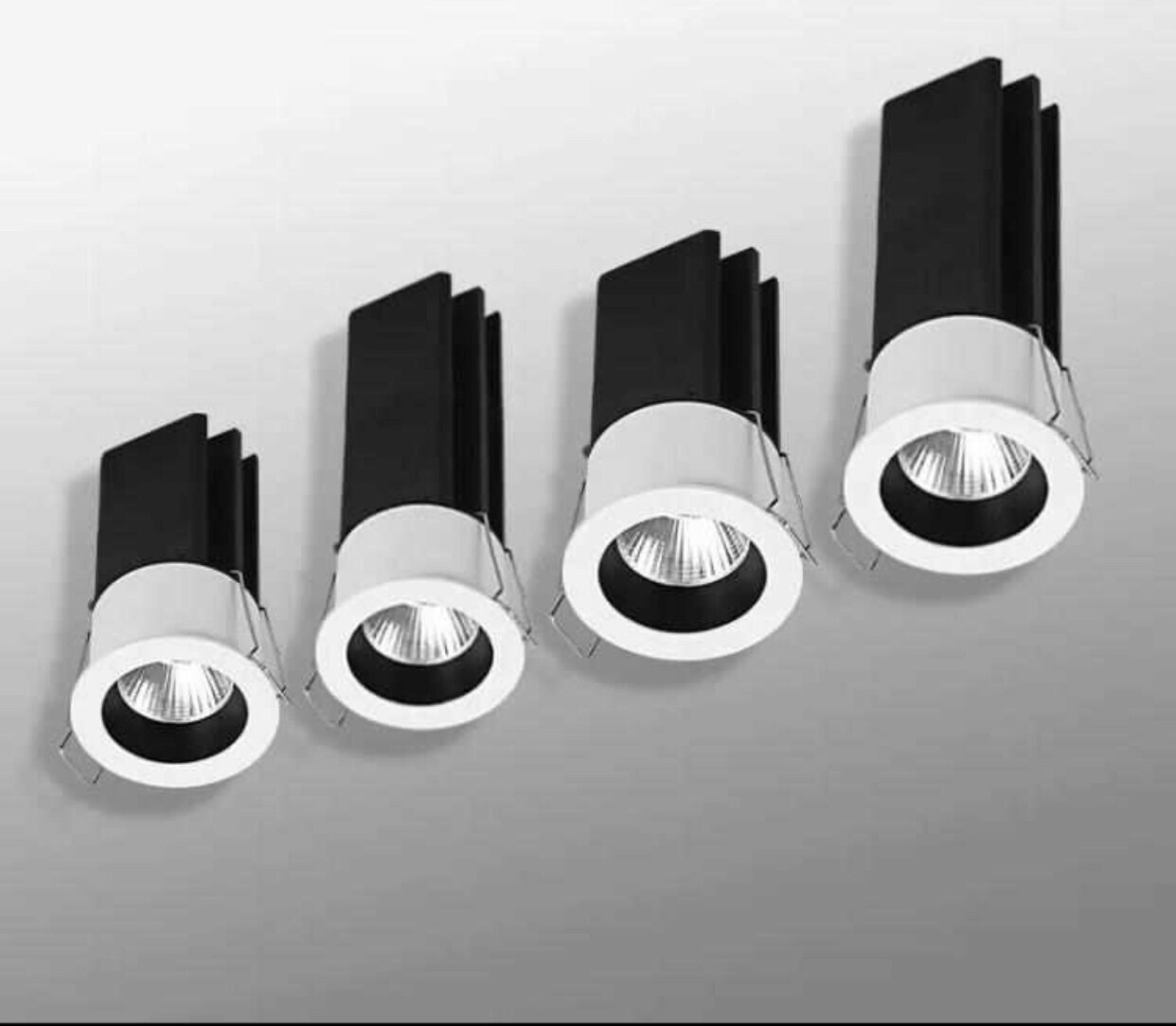
Choose a fixed COB spotlight when the target will not move: a reception desk, corridor artwork, a branded wall panel or a defined display niche.
Its clean aperture and consistent aim reduce adjustment errors, but a single fixed-beam, fixed-CCT fitting is a poor choice for an entire hotel floor with changing uses and layered guestroom lighting.
| Option | Best choice | Limitation |
|---|---|---|
| Fixed COB spotlight | Permanent desks, artwork, signage and architectural details | Cannot correct a misplaced beam after installation |
| Adjustable gimbal | Guestroom artwork, retail-style displays and meeting rooms needing aim flexibility | Moving parts cost more and can introduce visible glare |
| Track light | Hotels with changing displays, partitions or event layouts | Track and adapters remain visible |
| SMD downlight | Even, broad illumination across offices, corridors and general rooms | Less punch and control for accents |
| Recessed downlight | Discreet ambient light where uniformity matters | Fixed locations make future layout changes difficult |
| Wall washer | Vertical branding, textured walls, artwork and façades | Does not replace light aimed at desks or tables |
Use gimbals when sightlines, furniture or displays may change; use track lights when you expect frequent re-aiming. Select SMD or recessed downlights for broad ambient coverage, not concentrated highlights, and wall washers for vertical surfaces.
For cob spot light options, compare the complete luminaire’s delivered lumens, efficacy, beam distribution, photometric file and driver—not the COB label alone. In offices, a spotlight can meet average lux yet create a bright source in screen-viewing angles.
Specify colour, rendering and glare for people and surfaces
Use 2700–3000 K for guestrooms and intimate restaurants, where warmer light supports relaxation and makes timber, upholstery and skin tones appear natural. Use 3000–3500 K for reception areas, and 3500–4000 K for offices when alertness and visual contrast matter.
- Guestrooms: Specify Ra 90 or higher, especially near mirrors, wardrobes and artwork. Choose deep-set optics so the COB source is not visible from the bed.
- Reception areas: Use Ra 90 or higher to render faces, stone, wood and branded finishes accurately. Control glare at the desk and waiting seats.
- Restaurants: Specify Ra 90 or higher and request R9 data, because Ra alone does not show saturated-red performance in food, fabrics and artwork.
- Screens: Keep the luminous source outside normal viewing angles. A visible high-luminance COB image creates disabling reflections even when average illumination is correct.
- Workstations: Target about 500 lux on the maintained working plane, Ra 80 or higher and UGR 19 or lower. Use a larger aperture, baffle or wider beam instead of simply increasing wattage.
For COB spotlights for offices, request measured flicker data from the complete luminaire and driver, including PstLM and SVM where available. Confirm performance at full output and every dimming level; phase-cut, 0–10 V and DALI-2 drivers are not interchangeable. Ask for R9, CCT tolerance, photometric files and glare data before approving samples.
Check the ceiling, electrical supply and control system before ordering
Before ordering cob spotlights for hotels and offices, confirm the ceiling construction, support method, heat clearance, electrical supply and control protocol on the actual Hyderabad site. A nominally compatible fitting can loosen a stretch-ceiling membrane, overheat inside a shallow void or fail to dim with the installed system.
| Area | Confirm before approval | Failure if missed |
|---|---|---|
| Ceiling | Slab or independent support ring, cut-out diameter, trim overlap, driver access and fire classification | The membrane can deform, discolour or carry the luminaire’s weight |
| Thermal | Heatsink clearance, insulation contact rules and ventilation around the driver | Heat shortens LED and driver life |
| Electrical | Complete luminaire and driver rated for 230 V, 50 Hz; input range, power factor, THD and surge withstand | A generic “wide voltage” claim hides nuisance trips, flicker or premature failure |
| Maintenance | Driver replacement route, connector type and access above the ceiling | A failed driver forces fabric removal or ceiling damage |
| Controls | DALI-2, 0–10 V, phase-cut or non-dim operation; minimum load, dimming range and start-up behaviour | The spotlight may flicker, refuse low-level dimming or fail to respond |
| Emergency | Emergency-driver compatibility, maintained or non-maintained operation and test-switch arrangement | Normal lighting may work while emergency operation does not |
For guestrooms, meeting rooms and open-plan offices, test the complete luminaire with occupancy sensors, scene controls and the building-management system before approval. Confirm whether the driver supports the required control cable, addressing and emergency override.
Record the ceiling void depth, mounting height and driver location on the reflected ceiling plan. Approve one physical sample after checking glare from beds, desks and monitor-viewing angles, not only its light output.
Use a complete technical submittal to compare suppliers
Request a complete technical submittal before approving any quotation or sample from a cob spot light supplier in Hyderabad. The COB label alone does not establish beam quality, colour accuracy, efficiency or service life.
Request these documents and data:
- Exact LED package and driver manufacturer, model numbers, rated wattage, delivered lumens and luminaire efficacy.
- IES or LDT photometric file showing beam distribution, centre-beam candlepower and beam angle.
- CCT, colour tolerance, Ra and R9 values; request a full colour-rendering report where finishes, food or skin tones matter.
- Flicker measurements, including percentage modulation or Pst LM and SVM where available.
- LM-80 data and TM-21 projection, with the test temperature and drive current stated.
- Input range for 230 V, 50 Hz, power factor, THD, surge withstand and emergency-lighting behaviour.
- DALI-2, 0–10 V, phase-cut or non-dim driver details, including minimum load, dimming range and sensor or BMS compatibility.
- Dimensions, cut-out, operating ambient range, thermal data, warranty exclusions and replacement-driver availability.
Compare the submission, not the sample’s appearance.
| Evidence | Weak submission | Approval-grade submission |
|---|---|---|
| Photometry | “Narrow beam” claim | IES/LDT file with tested distribution |
| Lifetime | “50,000 hours” | LM-80/TM-21 basis and ambient limit |
| Controls | “Dimmable” | Driver protocol, range and start-up behaviour |
| Service | General warranty | Exclusions and replacement-driver plan |
The LightHouse can be evaluated on the same schedule: its COB spot light options should compete on documented luminaire performance, not headline wattage. A visually bright sample can still produce poor glare, weak R9 or incompatible controls.
Related items
 | Spot Lights for Residence, ₹850 The Light House LED Spot Light is designed to provide bright, focused, and energy-efficient lighting for residential, commercial, retail,... View product → |
LED LIGHTS ₹2300 Easy to install Premium material used for longer life and reliability Energy-efficient and environment-friendly Well-distributed diffused light,... View service → |
Frequently asked questions
How do you match a COB spotlight beam angle to mounting height?
Relate the beam angle to the mounting height, target size and spacing. Narrow beams suit focused targets from greater heights, while wider beams cover larger areas from lower ceilings.
When should you choose fixed or adjustable COB spotlights?
Choose fixed spotlights for stable layouts and consistent aiming. Choose adjustable formats when artwork, displays, furniture or task areas may move.
Which colour and glare specifications matter in hotels and offices?
Specify colour temperature, colour rendering, glare control and the finish of the illuminated surface. Offices need visual comfort for prolonged work, while hotels also need accurate finishes for materials, artwork and signage.
What should you check before ordering COB spotlights?
Confirm ceiling construction, cut-out or mounting dimensions, supply voltage, driver location, dimming protocol and control-system compatibility.
What belongs in a COB spotlight technical submittal?
Request the product datasheet, photometric files, wattage, lumen output, beam angle, CCT, CRI, UGR data, dimensions, driver details, controls compatibility and installation requirements.
Related products
 | COB Downlights | LED COB Lights | Indoor LED Lighting LED COB Downlight & COB Lights ₹1400 The Light House offers premium LED COB Downlights and COB Lights designed to provide bright, focused, and energy-efficient illumination for... View product → |
 | ₹2500 Cob spotlight with Cree led and Phillips driver View product → |
 | Spot Lights | LED Spotlights | LED Wall Washer | Architectural & Commercial LED Lighting LED Spotlights & LED Wall Washer ₹450 The Light House offers premium LED Spotlights and LED Wall Washers designed to deliver high-performance, energy-efficient illumination for... View product → |
 | ₹3200 Cob Downlight with Cree led and Philips drivers with 5years replacement warranty View product → |
Keywords